
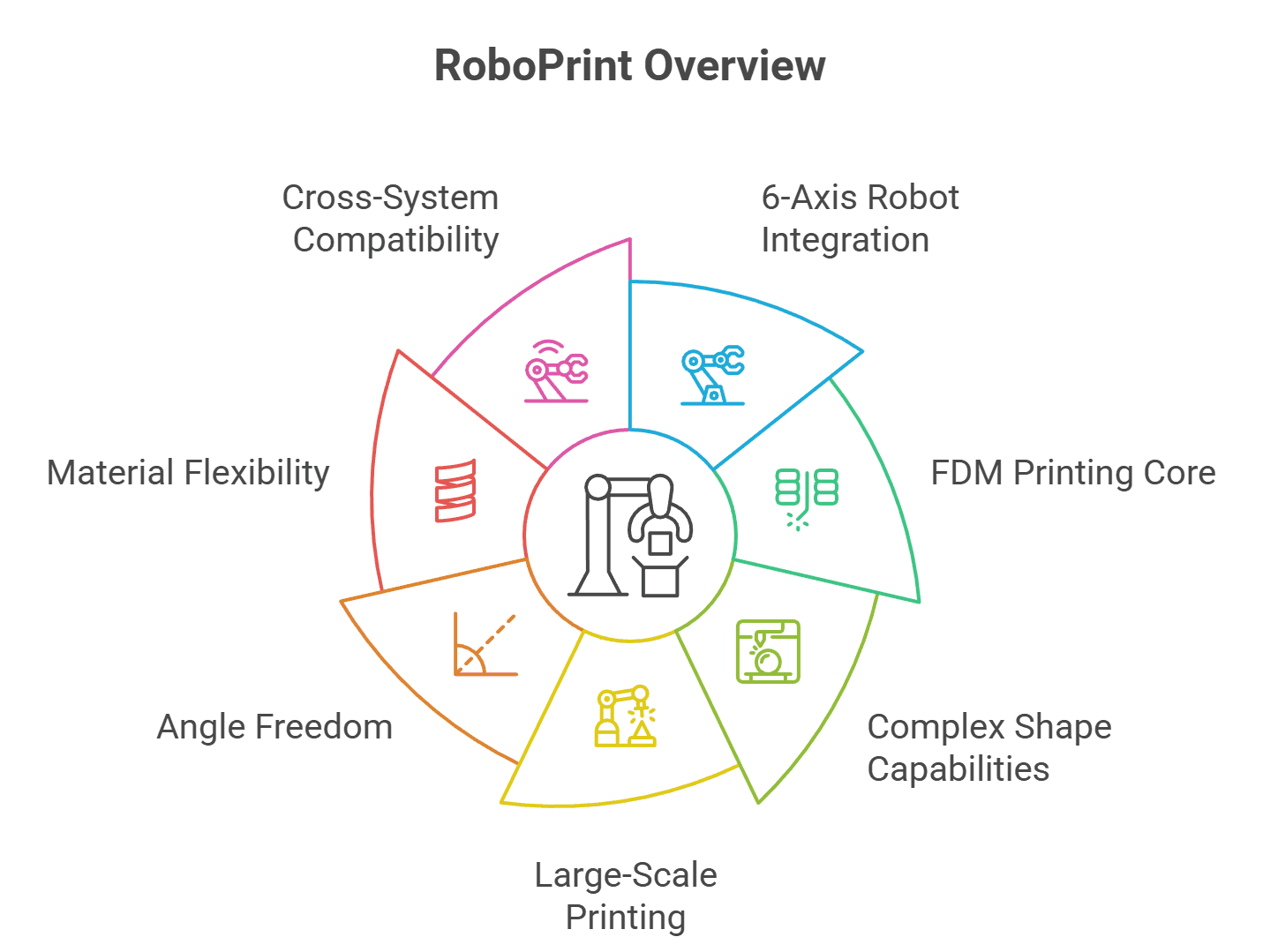
RoboPrint is our self-developed filament 3D-printing system designed specifically for 6-axis industrial robots.
Instead of using a fixed, rectangular printer frame like traditional FDM printers, we use the full motion range of a robotic arm. This gives us the accuracy of a desktop printer, but with the freedom, reach, and flexibility of an industrial robot.
At its core, RoboPrint works just like an FDM printer: it melts filament and lays it down layer by layer.
But because the robot controls every movement, rotation, tilt, angle, height, and reach. We can print in ways that normal printers simply cannot. Complex shapes, large objects, and unusual geometries become possible with the RoboPrint
01
Idea Exploration
We look at limitations in traditional FDM printing, the capabilities of 6-axis robots, and the challenges we encounter during real prints. From there, we outline what we want to explore

02
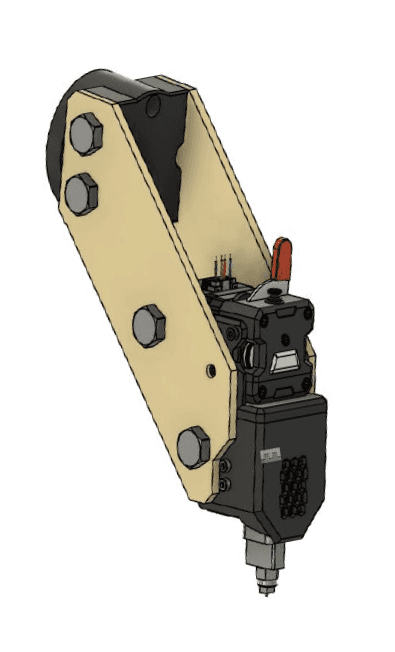
Concept & Prototyping
Once an idea shows potential, we turn it into an early prototype.
This can be anything from a rough CAD model to a quickly printed component or a test setup on the robot.
Prototyping helps us understand how the idea behaves in the real world.
03
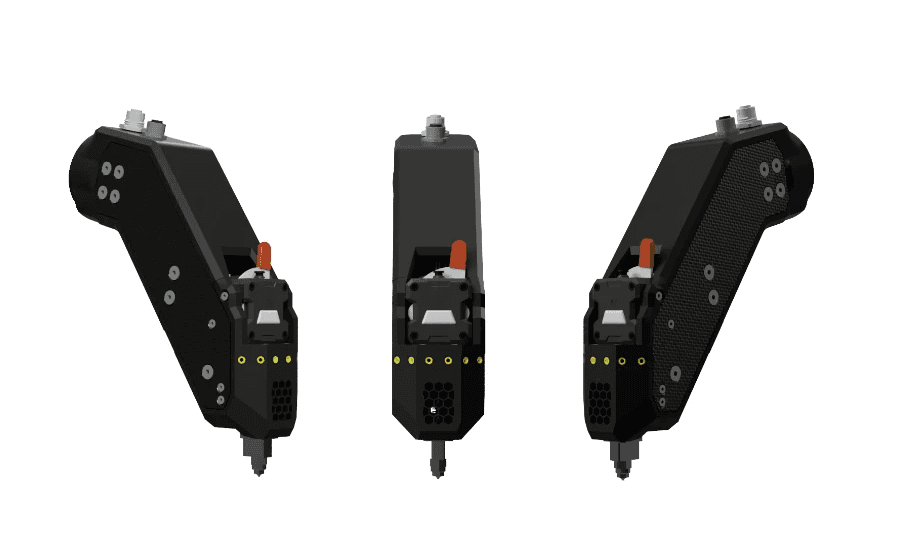
Software & Control Development
When the hardware concept works, we develop the software and control logic around it.
This includes everything that makes RoboPrint function smoothly.
04
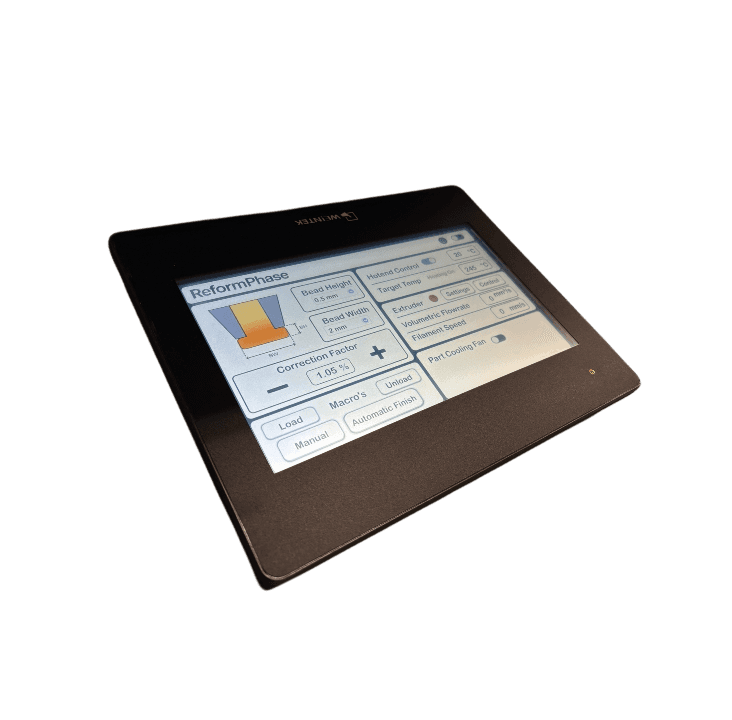
Finished product
After the system works on both the hardware and software side, we run print tests and analyze the results.
Layer quality, extrusion consistency, accuracy, overhangs, and surface finish all guide what we improve next.
We adjust, fix issues, and repeat the cycle until we are satisfied
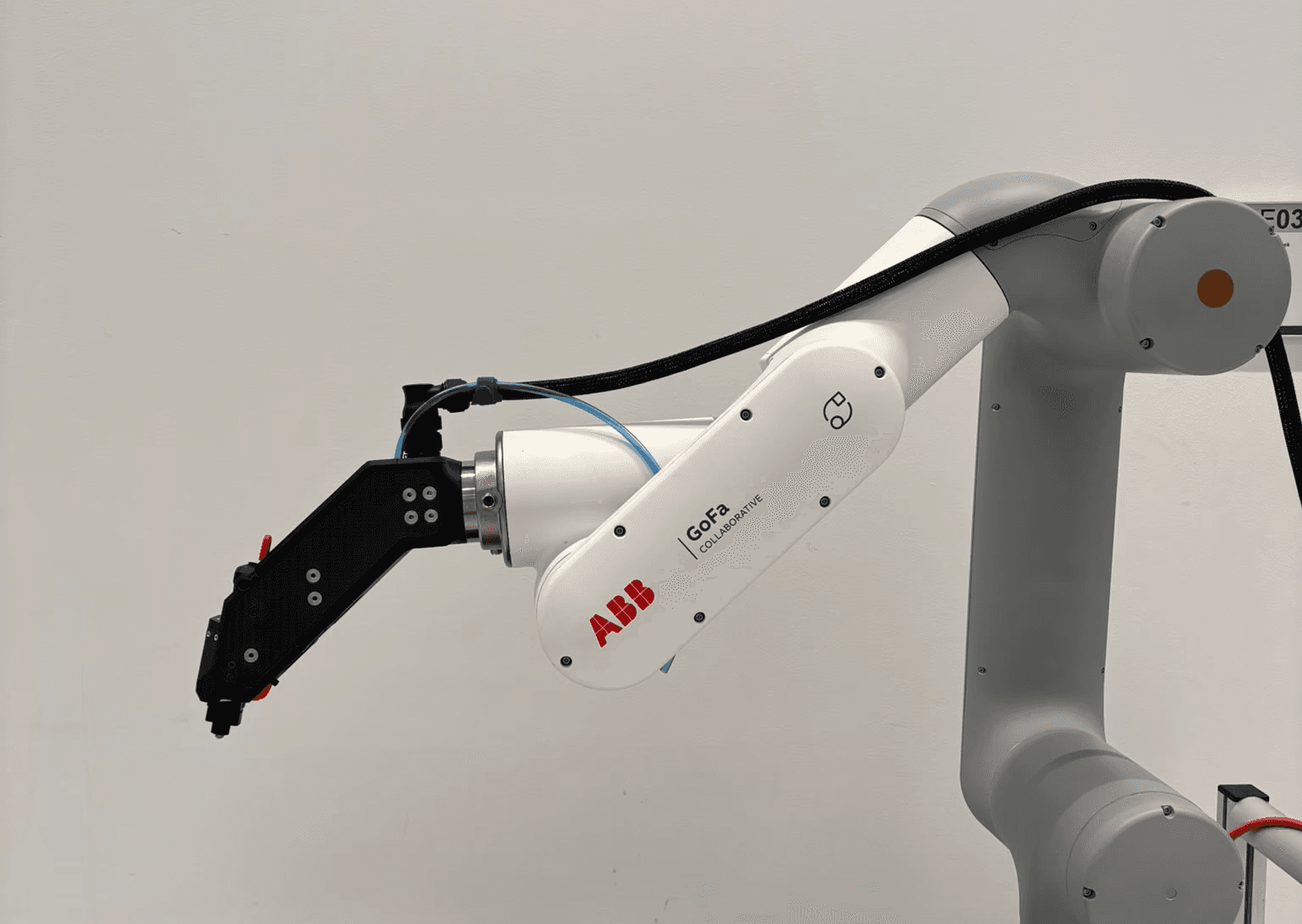
RoboPrint gives us a set of unique capabilities that combine the precision of a desktop FDM printer with the freedom and scale of a 6-axis industrial robot.Because the robot can move, rotate, and approach the print from different angles, we are not limited by a fixed frame or a traditional build volume.One of the biggest advantages is large-scale printing.The robot’s reach allows us to print tall parts, long objects, and shapes that extend far beyond what standard printers can handle, all while keeping smooth motion and reliable layer quality.Another key capability is angle freedom.Instead of printing only straight upward, we can tilt or rotate the toolhead to approach geometry in more efficient ways.This opens up new possibilities for complex shapes and makes certain overhangs or transitions easier to print.Because RoboPrint is filament-based, we can work with different materials and continuously experiment with new extrusion settings, cooling setups, and toolpath strategies.This makes the system not only flexible, but also a great platform for learning and trying out ideas.In short, RoboPrint lets us print bigger, smarter, and with more freedom than a traditional 3D printer — while still keeping the controlled accuracy we expect from FDM.